
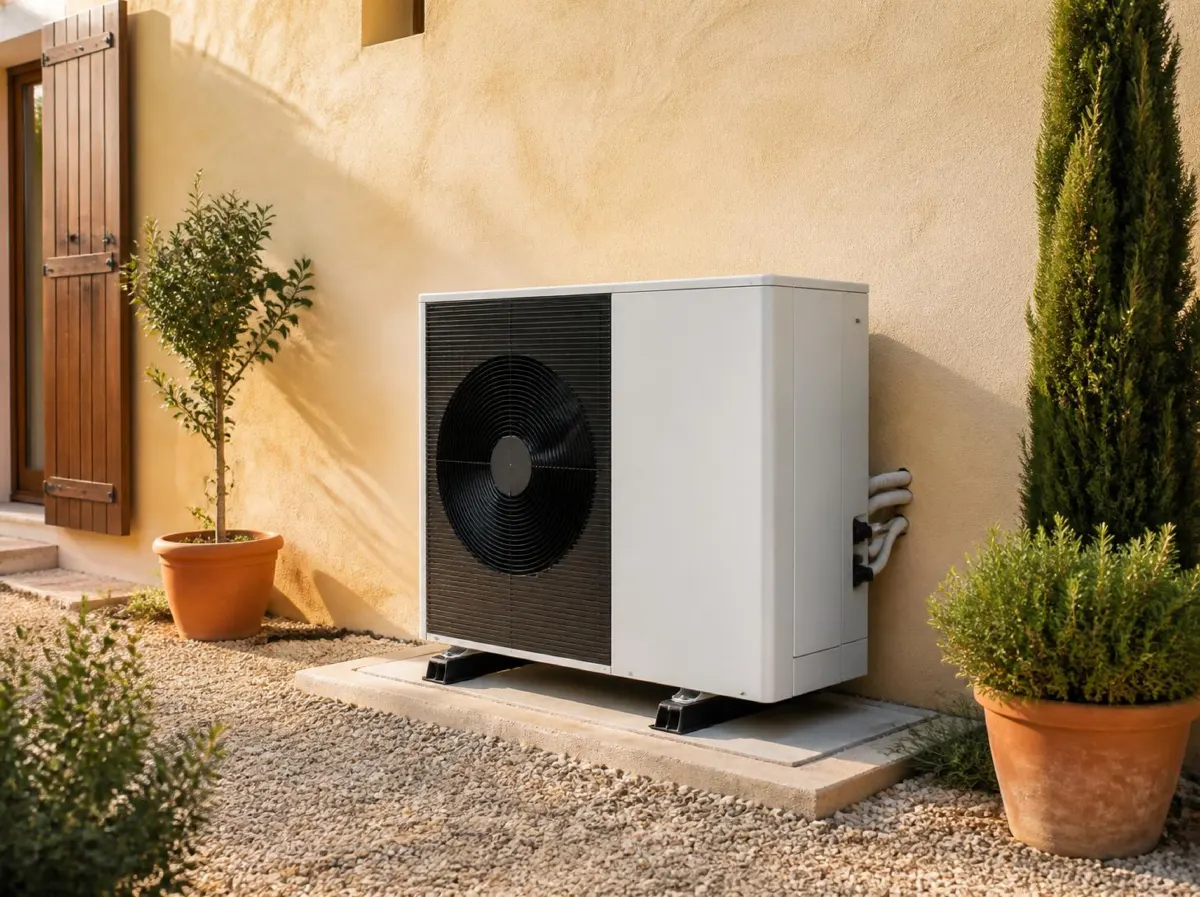
A heat pump captures the heat in outdoor air to warm your home and, depending on the model, your hot water. Its efficiency depends mainly on three things: the insulation of the home, the type of emitters (radiators, underfloor heating, wall units) and correct sizing.
The benefits of a heat pump
- Replace an oil, gas or old electric heating system with a more efficient one
- Also produce domestic hot water with some air-to-water models
- Keep your existing water radiators in many cases (air-to-water heat pump)
- Enjoy summer cooling with a reversible air-to-air system
- Reduce heating energy consumption, in a proportion that depends on the home and the old system
When is it relevant?
- An oil or gas boiler at the end of its life or costly to run
- Old electric radiators in a well-insulated home
- A home already fitted with a water heating circuit (radiators or underfloor heating)
- A renovation where insulation is dealt with at the same time or beforehand
- A house with outdoor space for the outdoor unit without nuisance
Limits and points to check
A solution that suits one home does not necessarily suit another. These points are systematically examined during the on-site study:
- Insulation level: a heat pump in a very leaky home will be oversized or inefficient
- The water temperature required by the existing radiators
- The position and noise of the outdoor unit, with regard to neighbours and condominium rules
- Appearance on the façade, governed by the local urban plan or the Architecte des Bâtiments de France in some areas
- The electrical power available at the meter
- Regular maintenance and handling of refrigerants by an authorised professional
Before signing with an installer, read about real situations encountered in the Var, the warning signs and your rights: choosing your installer.
How does the support work?
- Your request and the appointmentYou describe your project online (pre-study) or by phone. With your agreement, the adviser calls you back to arrange an appointment at your home.
- The full on-site study, free and with no obligationIn your presence: analysis of your bills and consumption, assessment of heating and hot water needs, insulation, emitters, unit positions and the electrical connection. If the project makes sense, the adviser presents the partner installer’s detailed offer.
- Time to decideYou can sign at the appointment or take time to think. Once you have agreed, you have the legal 14-day withdrawal period.
- The partner installer’s check visitAfter the withdrawal period, the partner installer visits the site in turn to confirm all the technical points.
- Formalities and any financial aidTown-hall declaration if the outdoor unit changes the look of the façade, condominium approval where applicable, any financial aid and, if needed, a financing application. If an essential approval is refused, the project is cancelled.
- Installation, checks and after-sales serviceOnce all approvals have been obtained, the installation is carried out by a qualified (RGE, QualiPAC) partner installer, certified to handle refrigerants and with ten-year insurance, followed by commissioning, adjustments and advice on use and servicing. The partner installer then provides after-sales service under its own guarantees and those of the manufacturers.
What influences the cost of your project
We do not give prices without a study: a price displayed online could not take your situation into account. The main factors that change the quote are:
- The type of heat pump (air-to-water or air-to-air) and its power
- Whether domestic hot water is produced
- Compatibility of the existing emitters or their replacement
- Removal of the old equipment (oil tank, boiler)
- Electrical work and unit positions
- The number of rooms to equip for an air-to-air system
Financial aid: whether aid exists, its amount and your eligibility depend on your situation (income, status, type of home), on the technical characteristics of the project and on the schemes in force at the time of the study. We check these points with you; no aid is guaranteed in advance.
The brands we offer
- DaikinAir conditioning and heat pumps
- Mitsubishi ElectricAir conditioning and heat pumps
- AtlanticHeat pumps, thermodynamic water heaters and air conditioning
For air-to-water and air-to-air heat pumps, we work with Daikin, Mitsubishi Electric and Atlantic. The model and output are chosen after a study of your home.
What French regulations say
- Refrigerants: handling them is restricted to companies holding a certificate of competence issued by an approved body (French Environmental Code). This is one of the conditions met by the partner installers to whom the installation is entrusted.
- Planning rules: an outdoor unit visible from the street may require a prior declaration at the town hall; in a condominium, the agreement of the owners’ meeting is often required.
- Neighbours: the location of the outdoor unit is chosen to limit noise, as neighbourhood noise regulations apply.
- Financial aid: MaPrimeRénov’ and the CEE energy-saving premiums require the work to be carried out by an RGE-qualified company using eligible equipment: this is a selection criterion for our partner installers. The amounts depend on your situation and on the rules in force at the time of the study.
- Mandatory maintenance: heat pumps rated between 4 and 70 kW must be serviced at least every two years by a professional (decree no. 2020-912 of 28 July 2020). A maintenance certificate is issued to you.
Heat pumps in the Var and western Alpes-Maritimes
The generally mild winters of the Mediterranean coast suit an air-source heat pump. Inland Var or in the hills around Grasse, lower temperatures call for more careful sizing.
Many houses built between the 1960s and 1990s are still heated with oil or direct electricity: they often gain the most from a study, provided insulation is checked at the same time.
See the communes we serve in the Var and the west of the Alpes-Maritimes.
Frequently asked questions
What is the difference between an air-to-water and an air-to-air heat pump?
An air-to-water heat pump heats the water of a radiator circuit or underfloor heating, and sometimes domestic hot water. An air-to-air heat pump delivers warm (and often cool in summer) air through indoor units.
Can I keep my current radiators?
Often, with an air-to-water heat pump, if the radiators are compatible with the water temperature produced. The on-site study checks this.
Should I insulate before installing a heat pump?
It is recommended when insulation is poor: heating needs fall, the heat pump can be less powerful and works in better conditions.
Is the outdoor unit noisy?
It makes operating noise that depends on the model and its position. The position is chosen to limit nuisance, taking neighbours and applicable rules into account.
Is financial aid available for a heat pump?
Schemes may exist depending on your situation and the equipment installed. Eligibility and amounts are checked at the time of the study, with no prior guarantee.
Complementary solutions
- Insulation: reduce heating needs
- Solar panels: produce part of your electricity
- Whole-home energy renovation
Our commitments
- A study of your situation before any proposal
- Clear explanations of feasibility, constraints and administrative steps
- No unverified promise of aid, savings or return on investment
- A callback agreement that you can withdraw at any time
Who carries out the installation? Agence IntExt, an Independent Business Manager (VDI Mandataire), advises you, studies your project and coordinates its delivery. The Agency does not carry out the works itself: the installation is entrusted to independent partner installers, selected for their qualifications (RGE, QualiPV, QualiPAC… depending on the solution) and their ten-year (décennale) insurance, so that the installation complies with the standards and regulations in force.
Request your heat pump pre-study
Under 2 minutes, no automatic price. An adviser analyses your request.