
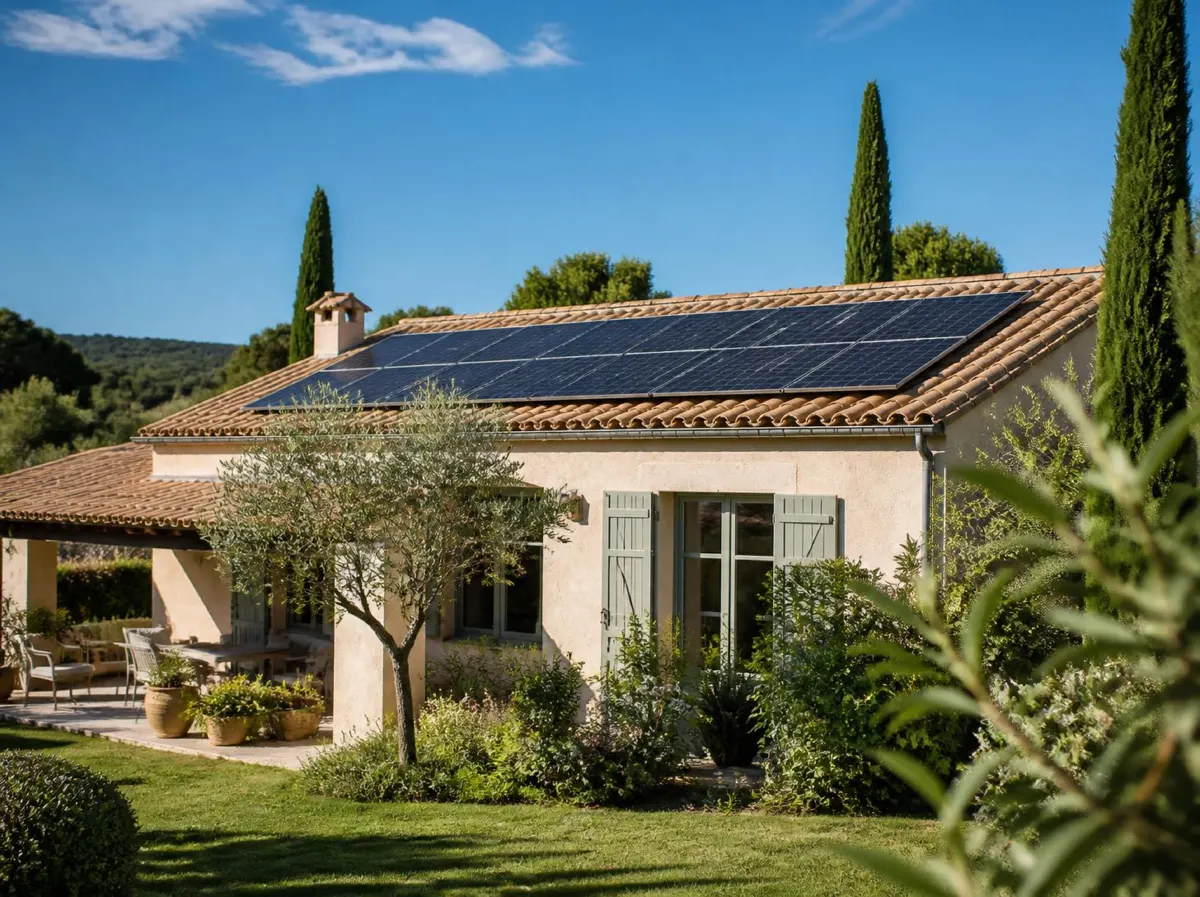
The Var and the west of the Alpes-Maritimes enjoy some of the best sunshine in mainland France. But the roof, its orientation, shading and your consumption habits must allow you to take advantage of it. That is exactly what the pre-study checks.
The benefits of a photovoltaic system
- Use the electricity produced by your panels directly during the day (self-consumption)
- Reduce the share of electricity bought from the grid, in a proportion that depends on your consumption profile
- Sell the unused surplus, under the buy-back contract applicable when you are connected
- Consider, where relevant, a battery to shift part of your consumption to the evening
- Make the most of a well-exposed roof and take part in the energy transition
When is it relevant?
- A south-facing roof, or east and west, with little shading
- High daytime consumption: home working, pool, air conditioning, electric vehicle, business activity
- A plan to replace your heating with a heat pump, which increases electricity use
- A roof in good condition, or one to be redone before installation
- A business or farm building whose consumption coincides with sunshine hours
Produce, use at the right time, store if it helps
Surplus sold to the grid now earns little: the buy-back tariff fell to around 4 cents per kWh in 2025. The value of an installation therefore lies mainly in the share of solar electricity you use yourself. We study three levers, in this order:
- Control your usage with a home energy management system (HEMS): it starts the water heater, heat pump, vehicle charging or pool pump when the panels are producing. Across about 200 projects analysed, adding a HEMS raised the self-consumption rate by 18 points on average.
- Store with a physical battery, to use in the evening what was produced during the day. It only pays off when sized to your consumption profile; combined with energy management, it can often be smaller.
- Consider a virtual battery: a contract that lets you recover the injected surplus later instead of selling it for a few cents. No equipment to install, but a subscription and billing terms to compare.
Plan for tomorrow’s uses
A heat pump, an electric vehicle or a thermodynamic water heater change your consumption considerably. We size the installation with the equipment you plan in mind, so it stays coherent for years.
Already have panels?
An existing installation can often be improved: adding energy management, a battery or an EV charger, or extending its power. Describe your current installation in the pre-study.
Figures source: “Le photovoltaïque en 2030” guide, Revolt.eco, 2026. Orders of magnitude from projects analysed by the publisher; not a guarantee for your installation.
Limits and points to check
A solution that suits one home does not necessarily suit another. These points are systematically examined during the on-site study:
- The condition and structure of the roof frame and covering
- Shading (trees, neighbouring buildings, chimneys, relief) which can sharply reduce output
- Planning rules: prior declaration at the town hall, local urban plan, opinion of the Architecte des Bâtiments de France in protected areas
- In a condominium, the agreement of the owners’ meeting
- Grid connection capacity and connection lead times
- Output depends on actual sunshine, orientation and your consumption: it cannot be guaranteed in advance
Before signing with an installer, read about real situations encountered in the Var, the warning signs and your rights: choosing your installer.
How does the support work?
- Your request and the appointmentYou describe your project online (pre-study) or by phone. With your agreement, the adviser calls you back to arrange an appointment at your home.
- The full on-site study, free and with no obligationIn your presence: analysis of your bills and consumption, survey of the roof (orientation, pitch, shading, condition of the covering), the electrical panel and access, comparison of the options (self-consumption, energy manager, virtual or physical battery). If the project makes sense, the adviser presents the partner installer’s detailed offer.
- Time to decideYou can sign at the appointment or take time to think. Once you have agreed, you have the legal 14-day withdrawal period.
- The partner installer’s check visitAfter the withdrawal period, the partner installer visits the site in turn to confirm all the technical points.
- Formalities and any financial aidPrior declaration at the town hall, grid connection request to Enedis, any financial aid and, if needed, a financing application. If an essential approval is refused, the project is cancelled.
- Installation, checks and after-sales serviceOnce all approvals have been obtained, the installation is carried out by a qualified (RGE, QualiPV) partner installer with ten-year insurance, followed by the electrical compliance certificate (Consuel), commissioning and setting up output monitoring. The partner installer then provides after-sales service under its own guarantees and those of the manufacturers.
What influences the cost of your project
We do not give prices without a study: a price displayed online could not take your situation into account. The main factors that change the quote are:
- The power of the system and the number of panels
- The type of roof (tiles, flat roof, steel sheet) and the mounting method
- Whether there is a storage battery
- The electrical work required (panel, protections, connection)
- Roof access and the safety measures to put in place
- The administrative steps specific to your commune
Financial aid: whether aid exists, its amount and your eligibility depend on your situation (income, status, type of home), on the technical characteristics of the project and on the schemes in force at the time of the study. We check these points with you; no aid is guaranteed in advance.
Solar power in the Var and western Alpes-Maritimes
On the coast as well as inland, canal or Roman tile roofs are the norm. Their condition and pitch determine the mounting method. In old town centres and near historic monuments, the opinion of the Architecte des Bâtiments de France may frame the appearance and position of the panels.
In the Var, strong summer demand for air conditioning makes self-consumption particularly coherent: solar output coincides with cooling hours. In the Alpes-Maritimes, relief and urban density make shading analysis decisive.
See the communes we serve in the Var and the west of the Alpes-Maritimes.
Frequently asked questions
Is my roof suitable for solar panels?
It depends on its orientation, slope, condition, shading and planning rules. The pre-study gives a first sort; the on-site study confirms it.
Is an east-west orientation possible?
Yes, in many cases. Output is spread over the day, which can even match some consumption habits better. The study checks this.
Do I need permission to install panels?
A prior declaration of works at the town hall is generally required. In protected areas, the opinion of the Architecte des Bâtiments de France may be needed. In a condominium, the owners’ meeting must agree.
Is a battery essential?
No. It can be useful if you consume mostly in the evening, but it increases the cost of the project. Its value is assessed case by case.
What is a home energy management system (HEMS)?
A small unit with an app that controls some appliances (water heater, heat pump, vehicle charging, pool pump) so they run when your panels are producing. It is often the first lever to use, before a battery.
Physical or virtual battery?
A physical battery stores electricity at home for the evening. A virtual battery is a contract that credits the injected surplus so you can use it later, with no equipment. The right choice depends on your consumption and on each offer’s terms: we compare them with you.
I already have panels: can my installation be improved?
Often, yes: energy management, a battery, an EV charger or an extension. A study of your current production and consumption shows what is worthwhile.
How much will I save?
We do not communicate guaranteed savings: they depend on actual output, your consumption, the electricity price and the conditions in force.
Complementary solutions
- Heat pump: replace an energy-hungry heating system
- Reversible air conditioning: use your solar output in summer
- Whole-home energy renovation
- Guide: produce, manage, store
Our commitments
- A study of your situation before any proposal
- Clear explanations of feasibility, constraints and administrative steps
- No unverified promise of aid, savings or return on investment
- A callback agreement that you can withdraw at any time
Who carries out the installation? Agence IntExt, an Independent Business Manager (VDI Mandataire), advises you, studies your project and coordinates its delivery. The Agency does not carry out the works itself: the installation is entrusted to independent partner installers, selected for their qualifications (RGE, QualiPV, QualiPAC… depending on the solution) and their ten-year (décennale) insurance, so that the installation complies with the standards and regulations in force.
Request your solar pre-study
Under 2 minutes, no automatic price. An adviser analyses your request.