
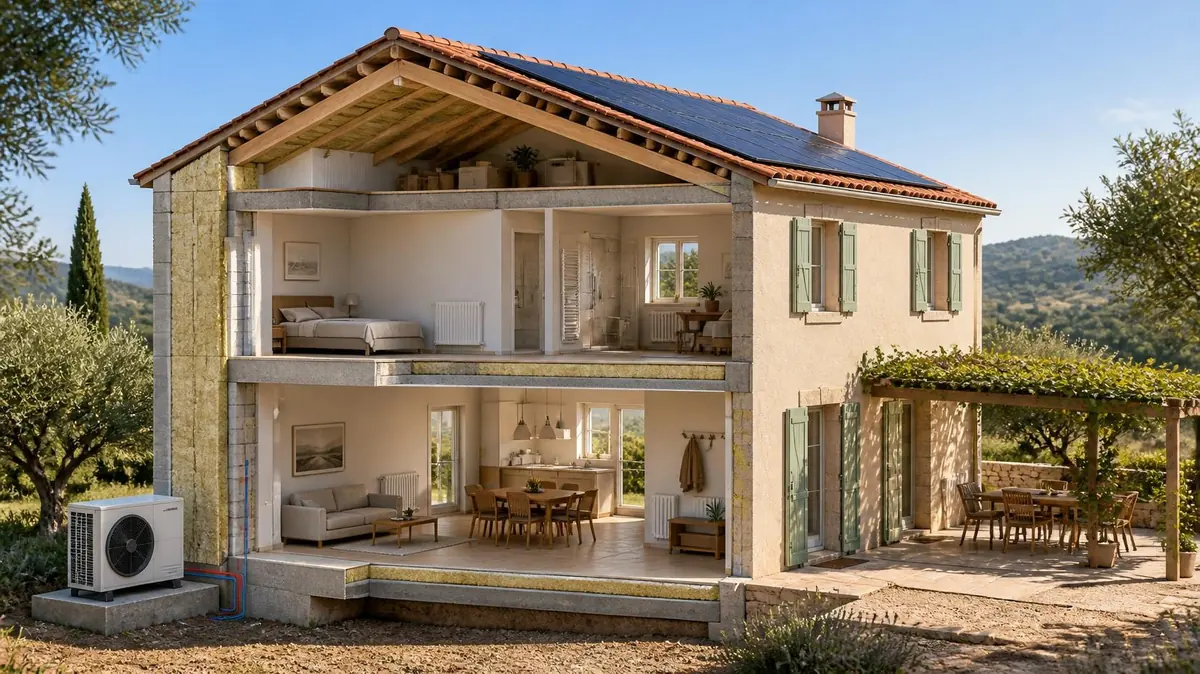
Installing efficient equipment in a home that loses its heat, or insulating without rethinking ventilation, rarely gives the results expected. A whole-home renovation starts from the condition of the home to define a coherent programme, which can be carried out in one go or in stages.
The benefits of a whole-home approach
- Works done in a logical order: first reduce needs, then meet them efficiently
- Correctly sized equipment, as it is calculated for an improved home
- Winter and summer comfort dealt with together
- A clear view of the project, even if carried out in several stages
- An improvement in the home’s energy performance, depending on the works carried out
When is it relevant?
- An older house, or one from the 1960s to 1990s, never renovated
- A recent purchase with works to plan
- A rental property whose energy performance needs to improve
- Several discomforts at once: cold, heat, bills, damp
- A planned sale for which an energy audit may be required depending on the home’s rating
Limits and points to check
A solution that suits one home does not necessarily suit another. These points are systematically examined during the on-site study:
- The overall budget and the possibility of phasing the works
- Occupation of the home during the works
- Coordination of the different trades
- Planning permissions depending on the works envisaged
- Conditions of access to any aid, which may require a specific route
Before signing with an installer, read about real situations encountered in the Var, the warning signs and your rights: choosing your installer.
How does the support work?
- Your request and the appointmentYou describe your project online (pre-study) or by phone. With your agreement, the adviser calls you back to arrange an appointment at your home.
- The full on-site study, free and with no obligationIn your presence: analysis of your bills and consumption, condition of the building, existing equipment, priorities and the logical order of works. If the project makes sense, the adviser presents the partner installer’s detailed offer.
- Time to decideYou can sign at the appointment or take time to think. Once you have agreed, you have the legal 14-day withdrawal period.
- The partner installer’s check visitAfter the withdrawal period, the partner installer visits the site in turn to confirm all the technical points.
- Formalities and any financial aidPlanning permissions depending on the works, condominium approval where applicable, any financial aid and, if needed, a financing application. If an essential approval is refused, the project is cancelled.
- Installation, checks and after-sales serviceOnce all approvals have been obtained, each part of the works is carried out by a qualified (RGE) partner company with ten-year insurance, in the planned order, then checked with you at handover. The partner installer then provides after-sales service under its own guarantees and those of the manufacturers.
What influences the cost of your project
We do not give prices without a study: a price displayed online could not take your situation into account. The main factors that change the quote are:
- The number and nature of the works items
- The initial condition of the home
- The level of performance targeted
- Phasing (in one go or in several stages)
- The administrative steps required
Financial aid: whether aid exists, its amount and your eligibility depend on your situation (income, status, type of home), on the technical characteristics of the project and on the schemes in force at the time of the study. We check these points with you; no aid is guaranteed in advance.
Energy renovation in the Var and western Alpes-Maritimes
The Mediterranean climate means summer comfort must be treated on a par with heating. A successful renovation combines insulation, solar protection, ventilation and, as needed, a heat pump or reversible air conditioning, sometimes with solar panels.
We support projects in the Var and the west of the Alpes-Maritimes: village houses, 1970s villas, renovated bastides, estate houses and business premises.
See the communes we serve in the Var and the west of the Alpes-Maritimes.
Frequently asked questions
In what order should the works be done?
As a rule: first the building envelope (insulation, windows, ventilation), then the equipment (heating, hot water), then energy production.
Can a renovation be done in stages?
Yes. What matters is that each stage prepares the next, to avoid, for example, oversizing equipment installed before insulation.
Is an energy audit needed?
It is mandatory in some cases, notably for the sale of certain homes depending on their energy rating, and some aid schemes may ask for one. We tell you if it applies to you.
Is the budget compulsory in the pre-study?
No. An optional range simply helps us propose realistic priorities.
Complementary solutions
Our commitments
- A study of your situation before any proposal
- Clear explanations of feasibility, constraints and administrative steps
- No unverified promise of aid, savings or return on investment
- A callback agreement that you can withdraw at any time
Who carries out the installation? Agence IntExt, an Independent Business Manager (VDI Mandataire), advises you, studies your project and coordinates its delivery. The Agency does not carry out the works itself: the installation is entrusted to independent partner installers, selected for their qualifications (RGE, QualiPV, QualiPAC… depending on the solution) and their ten-year (décennale) insurance, so that the installation complies with the standards and regulations in force.
Request your renovation pre-study
Under 2 minutes, no automatic price. An adviser analyses your request.